Day 5 Sleep Tip
Started by Ruth Harper Gough
5 points
Ruth Harper Gough


How many of us could use weight management support?
Well sleep plays a role in our metabolism and weight management. Comment with one take away from today's tip or your experience with this sleep connection.
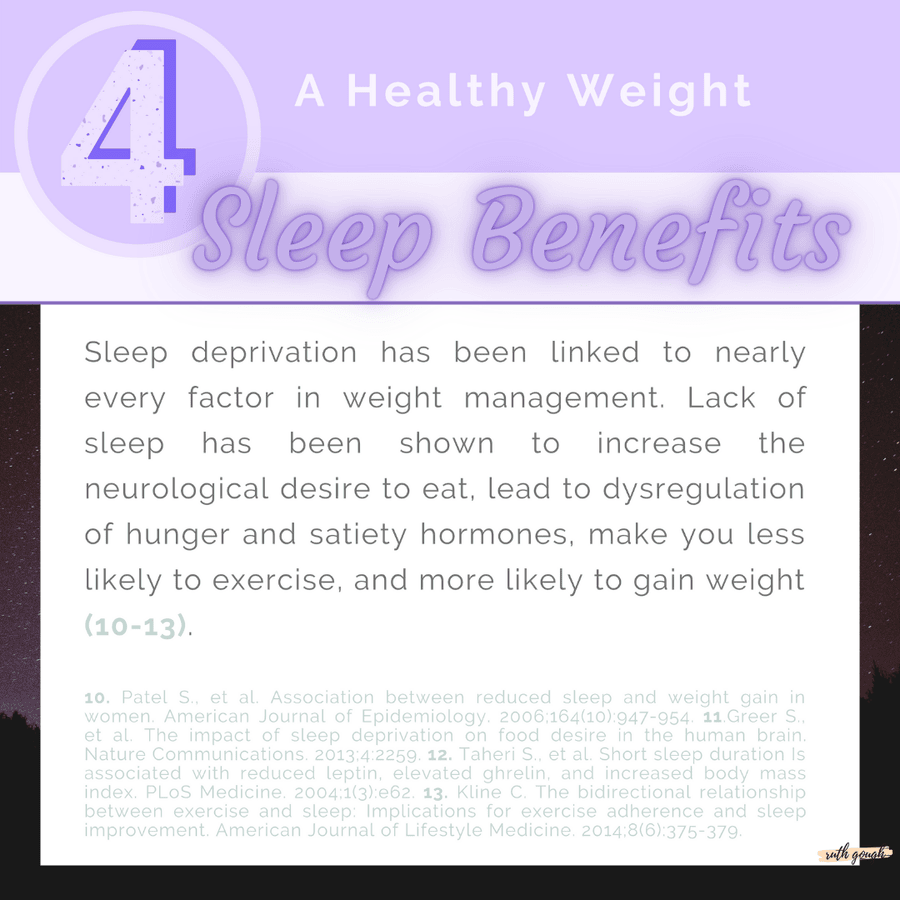
Sleep regulates two important hormones that influence appetite: ghrelin and leptin. Ghrelin tells your body it’s hungry, while leptin tells it you’re full.
Inadequate sleep disrupts these hormones. Short sleep duration increases ghrelin levels and decreases leptin levels. That means you feel more hungry throughout the day, but you’re less likely to feel satiated.
Increased hunger isn’t necessarily associated with bigger, more frequent meals. Instead, it’s associated with snacking. Research showed people who sleep less tend to snack on high-carbohydrate foods (like sugary sweets) to find more energy during the day. Foods with high sugar content lead to a higher risk of diabetes. Lack of sleep, poor dietary decisions, and obesity are directly related.
One large two-year study of 810 people (average age of 50 years) showed that sleep can predict weight loss success. Over a six-month period, those with self-reported sleep disturbance had less success losing weight and kept a higher fat percentage compared to those who reported sleeping an adequate amount. Other studies agree that sleep deprivation is associated with more fat deposits, particularly around the torso.
One of the main reasons people store more body fat in response to sleep deprivation is higher levels of ghrelin and an increased appetite, but the two-year study suggested there are underlying reasons related to how the body releases and uses energy in a fatigued state. High ghrelin levels promote fat creation and storage in the body. While this is a normal process to turn food into stored energy for our daily activities, high ghrelin levels due to sleep deprivation could interfere with healthy amounts of fat storage and production, but scientists don’t fully understand this link yet.
Poor sleep can cause weight to regain
The same large two-year study also found that sleep deprivation negatively affects weight maintenance. Those who self-reported sleep deprivation but lost fat were more likely to regain it. Regained fat is likely due to increased appetite and snacking, but other underlying reasons remain unclear.
5 points
Ruth Harper Gough
How many of us could use weight management support?
Well sleep plays a role in our metabolism and weight management. Comment with one take away from today's tip or your experience with this sleep connection.
Sleep regulates two important hormones that influence appetite: ghrelin and leptin. Ghrelin tells your body it’s hungry, while leptin tells it you’re full.
Inadequate sleep disrupts these hormones. Short sleep duration increases ghrelin levels and decreases leptin levels. That means you feel more hungry throughout the day, but you’re less likely to feel satiated.
Increased hunger isn’t necessarily associated with bigger, more frequent meals. Instead, it’s associated with snacking. Research showed people who sleep less tend to snack on high-carbohydrate foods (like sugary sweets) to find more energy during the day. Foods with high sugar content lead to a higher risk of diabetes. Lack of sleep, poor dietary decisions, and obesity are directly related.
One large two-year study of 810 people (average age of 50 years) showed that sleep can predict weight loss success. Over a six-month period, those with self-reported sleep disturbance had less success losing weight and kept a higher fat percentage compared to those who reported sleeping an adequate amount. Other studies agree that sleep deprivation is associated with more fat deposits, particularly around the torso.
One of the main reasons people store more body fat in response to sleep deprivation is higher levels of ghrelin and an increased appetite, but the two-year study suggested there are underlying reasons related to how the body releases and uses energy in a fatigued state. High ghrelin levels promote fat creation and storage in the body. While this is a normal process to turn food into stored energy for our daily activities, high ghrelin levels due to sleep deprivation could interfere with healthy amounts of fat storage and production, but scientists don’t fully understand this link yet.
Poor sleep can cause weight to regain
The same large two-year study also found that sleep deprivation negatively affects weight maintenance. Those who self-reported sleep deprivation but lost fat were more likely to regain it. Regained fat is likely due to increased appetite and snacking, but other underlying reasons remain unclear.
www.ncoa.org/adviser/sleep/sleep-and-weight-loss/
3835 points
Kelli Wood
Wow did not know this about the weight and sleep
3254 points
JoAnn Merrill
that was interesting I did not know that weight and sleep went together. I am hoping to change my sleep patterns with this challenge and maybe I will lose weight too.
605 points
Cindy Martinez
Wow. I had no idea. I am so grateful to have gained this information. I am hoping to find better sleep and gain all of the added benefits.
160 points
Marjie Jessop
I knew about sleep & weight but never understood the why! That was a pack of Information..
Last night I slept all night without waking and feel pretty good this morning! Still tired but not like I have been!!!
1059 points
Deborah Lavely
This definitely goes along with my commitment of being healthy in every aspect! It’s been a difficult road for me. I didn’t know the exact details of why sleep is important for maintaining a healthy weight, but I’m grateful for my new found knowledge. I’ve steady been trying to eat healthier. I do put chia seeds in my Metapower collagen as a health bonus.
1059 points
Deborah Lavely
I didn’t know about these 2 hormones & how sleep affects them. No wonder I’ve struggled to just maintain my weight as it is. Looking forward to a new/recharged zeal to achieve my health goal. Love your geeky information! ♥️👍
50 points
Josephine
All this information helping me realize how important it is to have regular meals.
1149 points
Sue Carlson
I sure see this in myself. When I don't sleep well, I want to snack. Even if I feel full, I have cravings and want to eat. It's really hard to resist the urge to snack.
145 points
Mandi
That’s Fascinating when I don’t get a lot of sleep I crave more of those fatty foods and high carb items. I have noticed my hormones being different and assume some of it had to do with sleep.
1600 points
Lucille Rock
Very interesting about the hormones. Prioritizing sleep is so important. I am making more of an effort to get at least 7 hours. I wake up at 5/6 a.m. It is very tempting for me to stay up late being the fact that I work evenings and get home around 8/9 p.m. I am committing to being in bed by 10 and fall asleep before 11.
879 points
Jennifer Sturges
I never knew why I craved some of the food that I did. I will be better to watch out for that now that I know
575 points
CHERYL N DOYLE
It seems there are several hormones that store fat. It also seems sleep deprivation impacts the hormones by activating.
I am attempting to increase my sleep time to 7 hrs.
430 points
Sandy Grebstad
I have always struggled with my weight. I now bounce from 135 to 132.
0 points
Deleted user
When my sleep is not as good, I do find myself snacking more. I find it comforting and something I can control. This information is helpful in order to be more mindful!
448 points
Natalie Holt
This!! I have struggled with weight loss for the last 13 years - ever since I started having kids. While other moms were able to drop their baby weight while nursing, my body held onto every last pound. I really hope that this is the missing piece to the puzzle of all the things I am doing to improve my health and will finally help me to start losing the excess weight.
2166 points
Cheryl McLean
I didn't know that sleep or lack of sleep also related to weight loss. I struggle with getting rid of excess pounds - Lately I have struggled more with sleep. For years I have only slept 5-6 hours a night - I keep hearing that I should be getting 7-8 hours a sleep a night - but don't know how to do that when I wake up after only 5 or 6 hours and can't get back to sleep. Looking forward to learning how all the pieces of the puzzle will fit together and improve my sleep, my weight and my health.
681 points
Nancy Gordon
It is true! I am finding as my sleep issues worsen, so does my metabolism. following a ketogenic diet and intermittent fasting brought my weight down during the past 6 years, but now with so much pain, and complete lack of sleep, I am again battling my weight increasing.