Day 6 Sleep Tip
Started by Ruth Harper Gough
5 points
Ruth Harper Gough


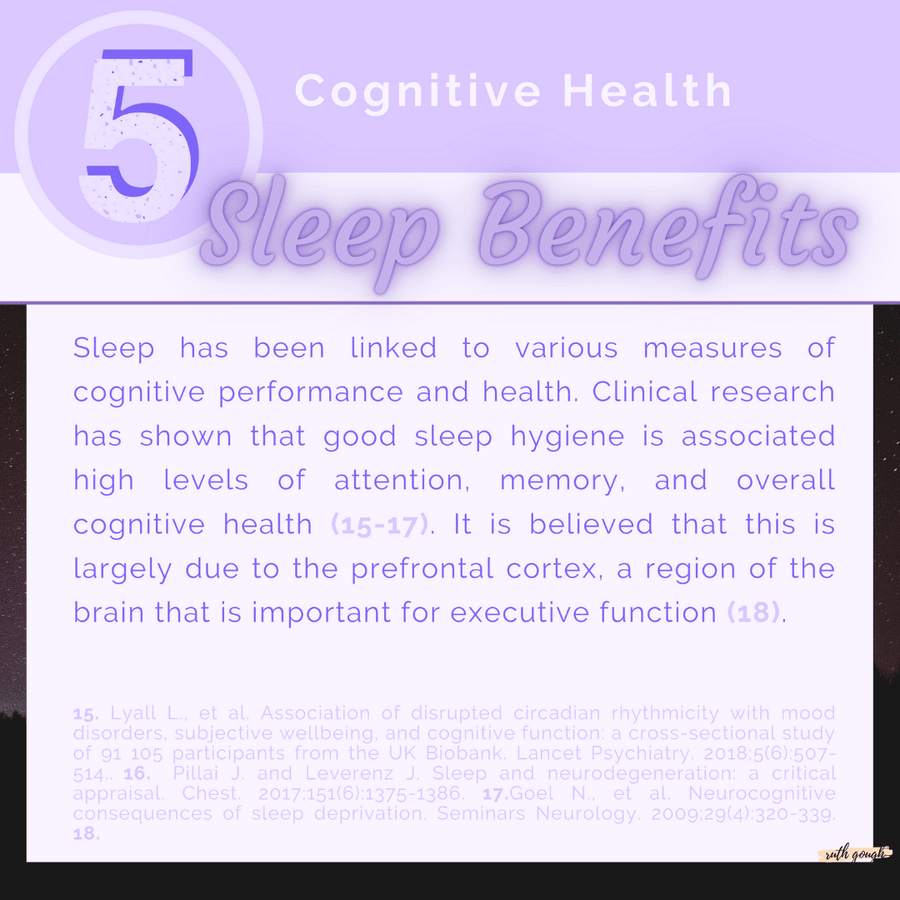
Sleep and Cognitive function. Think about the last time you had poor sleep, what did you notice about how well you were able to think, process, follow directions, connect with others, remember things?
During a typical night of sleep, an individual cycles through the three stages of NREM sleep, followed by a period of REM sleep every 90 to 120 minutes, several times per night. Both the brain and body experience distinct changes during these cycles that correspond to individual stages of sleep. During each part of this process, different chemicals in the brain become activated or deactivated to coordinate rest and recovery.
Poor sleep can take many forms, including short sleep duration or fragmented sleep. Without adequate sleep, the brain struggles to function properly. Because they do not have time to recuperate, neurons in the brain become overworked and less capable of optimal performance in various types of thinking.
What Are the Short-Term Cognitive Impacts of Poor Sleep?
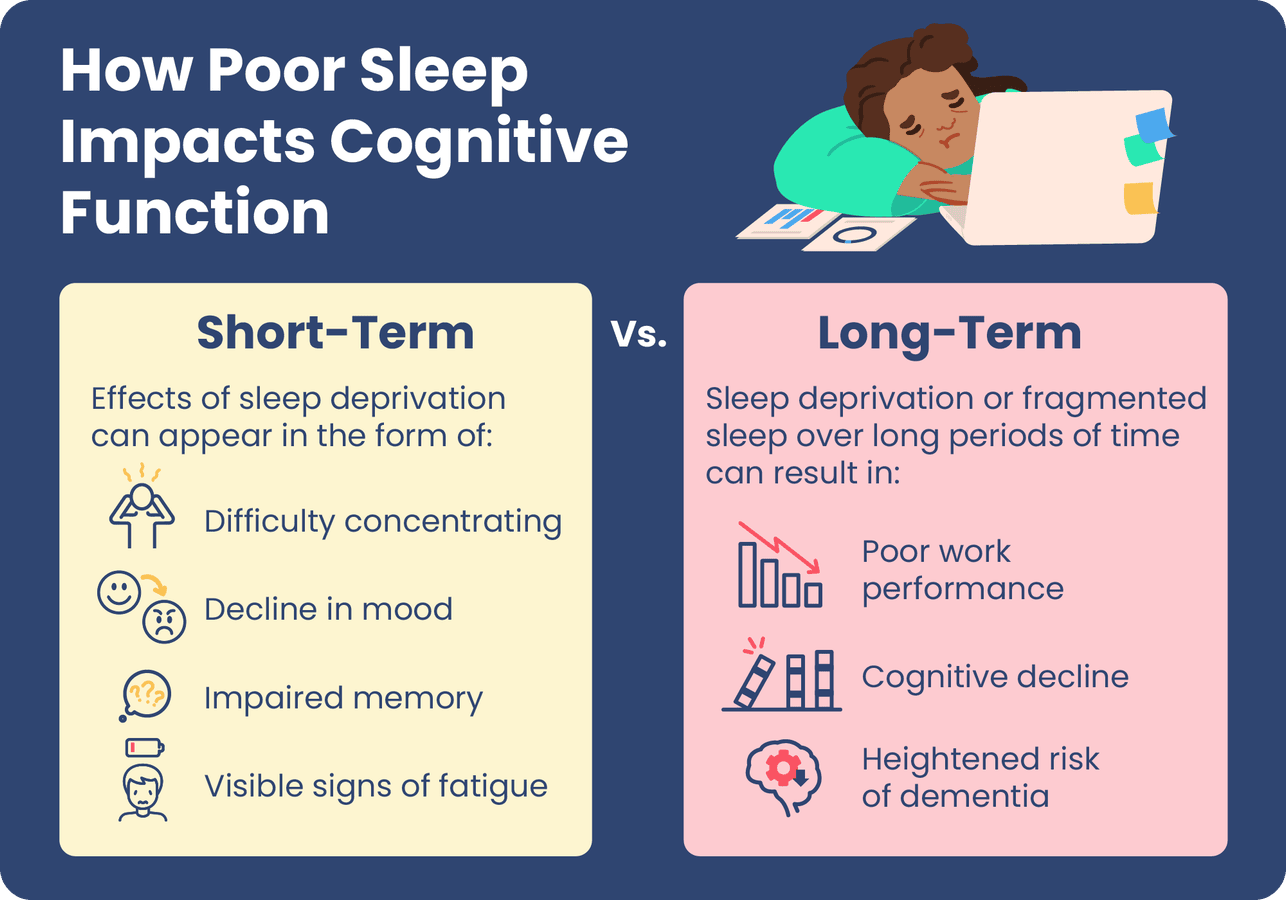
Poor sleep can harm intellectual performance, academic achievement, creative pursuits, and productivity at work. The cognitive impacts of poor sleep can also create safety risks, including drowsy driving. Motor skills, keeping rhythm, and even some types of speech can decline without proper sleep. The potential short-term impacts of poor sleep are wide-ranging:
*Excessive Sleepiness: Drowsiness and fatigue are common daytime effects of a night of poor sleep. In response to excessive fatigue, a person may inadvertently nod off for a few seconds, which is known as a microsleep.
*Poor Attention Span: Poor sleep reduces a person’s attention, as well as their learning and processing. A lack of sleep has also been found to induce effects that are similar to being drunk, which slows down thinking and reaction time.
*Reduced Adaptability: Some studies have found lack of sleep to hinder cognitive flexibility, reducing the ability to adapt and thrive in uncertain or changing circumstances. A major reason this occurs is rigid thinking and “feedback blunting” in which the capacity to learn and improve on-the-fly is diminished.
*Reduced Emotional Capacity: Poor sleep can also alter how emotional information is understood. When learning something new, analyzing a problem, or making a decision, recognizing the emotional context is often important. However, insufficient sleep impedes the ability to properly process the emotional component of information.
*Impaired Judgment: In some cases, this dysregulated emotional response impairs judgment. People who do not get sufficient sleep are more likely to make risky choices and may focus on a potential reward rather than downsides. It can be difficult to learn from these mistakes, since the normal method of processing and consolidating emotional memory is compromised due to lack of sleep.
What Are the Long-Term Cognitive Impacts of Poor Sleep?
Insufficient sleep and sleep fragmentation are frequently associated with cognitive decline and dementia. Furthermore, in people already diagnosed with dementia, poor sleep has been linked to a worse disease prognosis. Some cognitive effects of poor sleep can be felt immediately, but mounting evidence shows that sleep influences your long-term risk of cognition issues:
Impaired Memory: Both NREM and REM sleep appear to be important for broader memory consolidation, which helps reinforce information in the brain so that it can be recalled when needed. NREM sleep has been linked with declarative memory, which includes things like basic facts or statistics, and REM sleep is believed to boost procedural memory such as remembering a sequence of steps. Poor sleep impairs memory consolidation by disrupting the normal process that draws on both NREM and REM sleep for building and retaining memories.

Alzheimer’s Disease: Research shows that sleep helps the brain conduct important housekeeping, such as clearing out potentially dangerous beta amyloid proteins. In Alzheimer’s disease, beta amyloid forms in clusters, called plaques, that worsen cognitive function. Studies have found that even one night of sleep deprivation can increase the amount of beta amyloid in the brain.
sleepfoundation.org
5 points
Ruth Harper Gough
Sleep and Cognitive function. Think about the last time you had poor sleep, what did you notice about how well you were able to think, process, follow directions, connect with others, remember things?
During a typical night of sleep, an individual cycles through the three stages of NREM sleep, followed by a period of REM sleep every 90 to 120 minutes, several times per night. Both the brain and body experience distinct changes during these cycles that correspond to individual stages of sleep. During each part of this process, different chemicals in the brain become activated or deactivated to coordinate rest and recovery.
Poor sleep can take many forms, including short sleep duration or fragmented sleep. Without adequate sleep, the brain struggles to function properly. Because they do not have time to recuperate, neurons in the brain become overworked and less capable of optimal performance in various types of thinking.
What Are the Short-Term Cognitive Impacts of Poor Sleep?
Poor sleep can harm intellectual performance, academic achievement, creative pursuits, and productivity at work. The cognitive impacts of poor sleep can also create safety risks, including drowsy driving. Motor skills, keeping rhythm, and even some types of speech can decline without proper sleep. The potential short-term impacts of poor sleep are wide-ranging:
What Are the Long-Term Cognitive Impacts of Poor Sleep?
Insufficient sleep and sleep fragmentation are frequently associated with cognitive decline and dementia. Furthermore, in people already diagnosed with dementia, poor sleep has been linked to a worse disease prognosis. Some cognitive effects of poor sleep can be felt immediately, but mounting evidence shows that sleep influences your long-term risk of cognition issues:
sleepfoundation.org
3835 points
Kelli Wood
I did not know; I have had a lot of this
1600 points
Lucille Rock
My parents were so good at making sure we were in bed at an early time. I remember in the summer I would get upset for having to go to bed when it was still light out. (It was 8/8:30 still enough time for a kid to have more fun) I can see how that benefited is. I struggle to get my young teens in bed by 10 in the summer. I have to do better.
605 points
Cindy Martinez
I needed to hear this great information. Thank you
2640 points
mlclark0208@windstream.net
I definitely feel the cumulative effects of not sleeping well. Just the feeling of sluggishness through day and easily getting sidetracked.
3254 points
JoAnn Merrill
great info I need to get a tracker to see if I get good sleep or not some days I feel great others tired and slow
50 points
Josephine
My smart watch was just delivered. Now I need to figure out how to use it!
145 points
Mandi
The effects of not getting enough sleep is a real thing. I see each of the effects of not getting enough sleep in my life.
1149 points
Sue Carlson
Wow! I don't like the long term effects at all. My mom had dementia.
430 points
Sandy Grebstad
I get foggy brain but never know if it is because of poor sleep or migraines..
575 points
CHERYL N DOYLE
I'm seeing the affects of sleep depravity in NY sister 5 ys younger than me with sequence of instructions. You nee to tell her step 1, then step 2 after she completes the previous step, & so on.
0 points
Deleted user
A lack of sleep definitely affects my mood and makes it hard to concentrate.
448 points
Natalie Holt
I have definitely experienced this at different times in my life! I could sure use a cognitive lift.
2166 points
Cheryl McLean
I know that when I don't get enough sleep - I have a short fuse and get frustrated and angry over little things that would not bother me if I get the sleep that I need. I have experienced any of the things listed in the short term list above and know that sleep is a connection with them, but often struggle with getting 7-8 hours of sleep - 5-6 seems like my norm.
681 points
Nancy Gordon
I suffer terribly from poor sleep, short duration of sleep, little to no REM sleep. I truly believe the little sleep I do get is due to the DoTerra products I use. I use the entire line, and reapply oils and the Serenity Stick when I awake. I rely on diffusing Serenity, Breathe, Adaptiv and sometimes OnGuard at my bedside every night. Lack of sleep absolutely impairs my concentration and cognitive sharpness. I also suffer from severe sciatic pain which impairs my sleep, but also I believe is worsened due to a lack of restorative sleep. All of this as you can imagine impairs my mood and patience.
879 points
Jennifer Sturges
I remember having really bad sleep issue when I worked in the military with rotation shift work. It got alot better when I finally started working straight days. It explains alot of the issue I had but didn't know I had cause I thought it was normal.
60 points
Sara McNeil
I notice this a lot more as I get older-my ability to focus or remember things when I don't sleep well is a struggle!